The Jukola Relay is not by chance the finest and most atmospheric event of the Finnish summer.
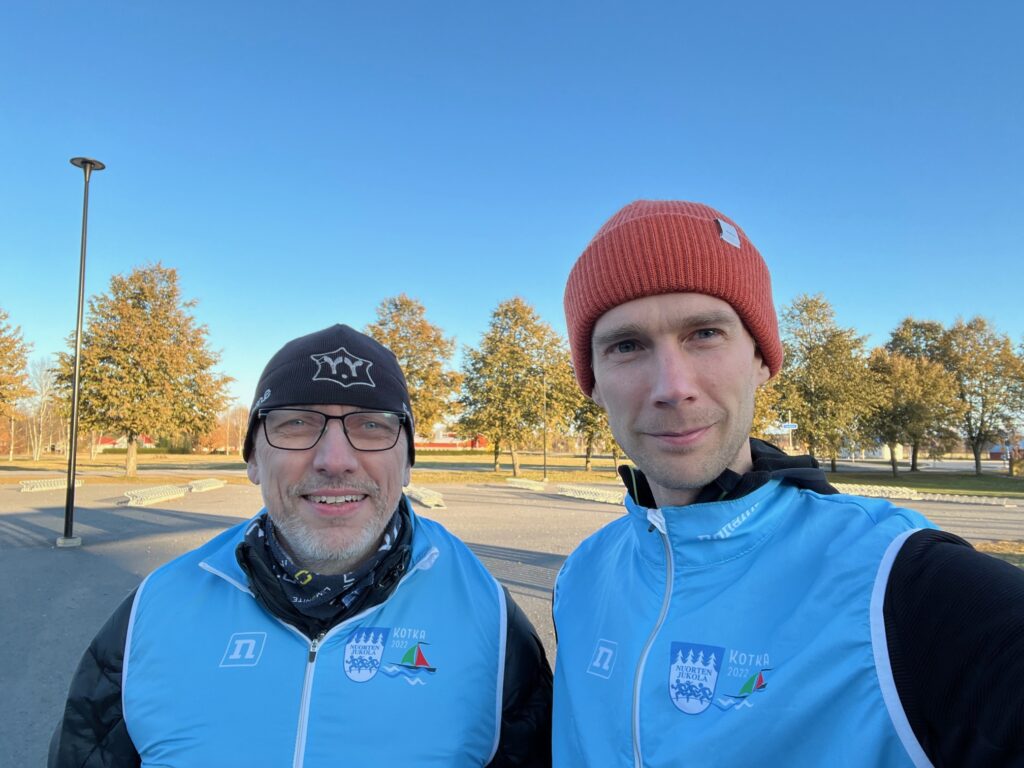
As part of safeguarding the event’s quality, an annual knowledge transfer meeting is held where the organisers of the past summer’s Jukola share their experiences with future organisers. This autumn it was organised in Mikkeli by the organisers of the 2025 Jukola. We Kotka-Jukola organisers were also present again, from the course team myself, Ari Heinola and Janne Niskanen. In previous years our own organising turn was relatively far away, but now there are about 600 days until Kotka-Jukola, and the more intensive work can begin.
“Jukola is on loan for a year – return it in good condition”
At the meeting, the entire arc of the arrangements was once again examined thoroughly, from the planning phase to the dismantling of the event. So what does the course-setting team’s work involve? Briefly put, the competitive performance from the K-point to the last control is the course setters’ domain. Course planning is naturally central, but it is not the whole story. TV controls, drink stations, control structures, consideration of sensitive natural sites and forestry, mapping, bagging and numbering the maps, control supervision: the whole must be designed and organised by the course team.
The list is long, yet apart from the TV production it is familiar fare in all events. When the Jukola Relay has nearly 20 000 participants, the work in many areas changes quite a bit. A truckload of maps is ordered from the printer, so the processes for sorting, bagging and checking the maps must correspond to industrial-scale operation. Nearly 100 000 cups and several cubic metres of water and sports drink are ordered for the drink stations, and in addition to logistics and resourcing it must be ensured that no litter ends up in the terrain. Large participant numbers also require more precise planning of forking, terrain wear and control load. Many things that in smaller events can be handled at the last minute should be carefully planned well in advance.
The high esteem of the Jukola Relay is also something that features prominently in course-setting work. Alongside the World Championships this is the brightest shop window of orienteering, which places a particular responsibility on the course setters. An A-class map and good, demanding courses for both elites and recreational runners are the starting point, but not yet enough. Special attention must be paid to the needs of the broadcast so that a magnificent orienteering race can be made into an engaging TV programme. Nor can we forget the classic “bush whispering” to radio or the media representatives taking photos of the event.
“Course setting, in addition to the course design itself, is to a large extent collaboration and organisation.”
Orienteers are always guests in forests owned by others, so landowners’ appreciation of the event is also important. For Kotka-Jukola a nature survey has already been carried out to account for sensitive natural values. The race will be organised so that there is no harm to nature, forest and game management or recreational values. Permission to use the terrain for the competition is sought from every landowner, and landowners are invited to the event as guests of honour. There are hundreds of forest parcels in the competition area; we hope to see landowners in great numbers on site watching the race in June 2026.
One often hears the idea that course-setting work, especially in major events, is the art of compromise. In my view, it is about reconciling different needs. It is the course setter’s professional skill to design the competition so that different stakeholders feel it was made with them in mind. When that happens, the course setter has succeeded. Secretly the course setter is also pleased when the courses’ demands force even the top teams’ GPS dots onto different route choices and impressive squiggles while searching for controls.
There is certainly quite a workload still ahead for the course team, as the knowledge transfer meeting again made clear to us. Fortunately the work is already underway, and the pace will tighten as the event approaches. We intend to write here on this blog from time to time about how the work is progressing. The initial instruction is clear in our minds: after us, Jukola will be returned in good condition to the next organisers!
Kotka-Jukola course setter,
Tuomas Mattila