
The Jukola Relay is a source of pride for landowners: “The most sensitive areas are always left untouched.”
It would be impossible to organize the Jukola Relay without seamless cooperation with the forest landowners in the competition area. Hosting Jukola on one’s own land is often also a matter of pride.
– The fact that Jukola was run “in our forest” is a once‑in‑a‑generation highlight for many people, says Jussi Pasanen.
Pasanen knows this well from personal experience. The Pasanen family team is heading to the Jukola Relay in Kotka, and 25 years ago Pasanen himself served as Secretary General of the Nikkari Jukola held in Jurva.
– That role taught me a great deal that has stayed with me throughout my life, Pasanen recalls.
Today, Pasanen works “on the other side of the counter” as Managing Director of the South Ostrobothnia Forest Management Association, representing landowners.
– Landowners are, quite naturally, the most important partners for the organizers of the Jukola Relay, Pasanen states.
Landowners are also a key resource for the organizers.
– All landowners are traditionally invited to follow the competition, and among them you’ll also find plenty of kökkä people — as we call volunteers here — Pasanen explains.
Without the landowners’ permission, organizing the relay would be impossible.
– Terms are agreed individually with every landowner on how activities may be carried out on their land.
The number of agreements varies each year depending on land ownership conditions. During the Nikkari Jukola, around two hundred contracts were made.
– Our landholdings are long and narrow. In some years, Jukola has been organized almost entirely on land administered by the Finnish Defence Forces.
The Most Sensitive Areas Are Left Untouched
Orienteers are not allowed access to every corner of the forest. Course planners take into account all agreements made with landowners.
– Especially sensitive areas, such as young forest stands at certain growth stages, wildlife protection areas, and particularly valuable natural sites, are marked on maps and excluded from the competition.
For the Jukola Relay, it is a matter of honor that the terrain is left in as good condition as possible after the participants and spectators leave.
– All structures and litter are removed. Of course, tracks are formed in the terrain, but surprisingly quickly grass grows back and covers them.
A Forester’s Story
Especially in past decades, the forest was a natural environment in rural areas — both for childhood hobbies and for future careers — and this was true for Pasanen as well.
– At the primary school in Leppäselkä, Keitele, orienteering was part of the curriculum every autumn and spring. That’s where it all began.
The forest also became Pasanen’s profession. He graduated as a forestry engineer from what was then the Kotka University of Applied Sciences in 1997.
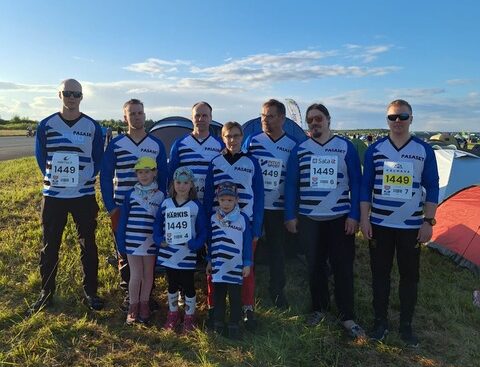
Traditions are now being passed on to the next generation. In the Pasanen family team, there are orienteers from three generations.
– In addition to myself, the team includes my uncle, my brother, two sons, and two cousins.
The Pasanen family first took part in the Jukola Relay in 2019 in Kangasala to celebrate Pasanen’s 50th birthday.
– We’re happy to come to Kotka as well. I can’t remember whether I already visited the competition terrain during my student years.
What motivates the family team is the joy of being together and of orienteering — along with a very cautious performance goal.
– Jokingly, we’ve talked about finishing somewhere in the top thousand.
Pasanen has reserved the third leg for himself.
– It’s the longest leg and takes place during the early summer morning hours, when nature and the sounds of the night are at their most beautiful.
Pasanen first experienced the Jukola Relay as an orienteer in 1989 with the Nuju team from Keitele. Since then, he has taken part in around twenty relays.
After the Storm
At the moment, much of the Forest Management Association’s managing director’s time is taken up by the Hannes Day storm that struck last December.
– There are still hundreds of thousands of cubic meters of fallen timber. Because of the warm spring weather, time is quickly running out for harvesting saw logs before insect damage makes it unviable, Pasanen laments.
Pulpwood in the storm‑damaged areas has a little more time to reach mills before it deteriorates.
– In this situation, the fact that some wood may remain in the forest as deadwood offers little comfort to landowners, Pasanen says.
Pasanen challenges Stefan Borgman from Sipoo to take part in the sixth installment of the article series Life in the Jukola Forests.