
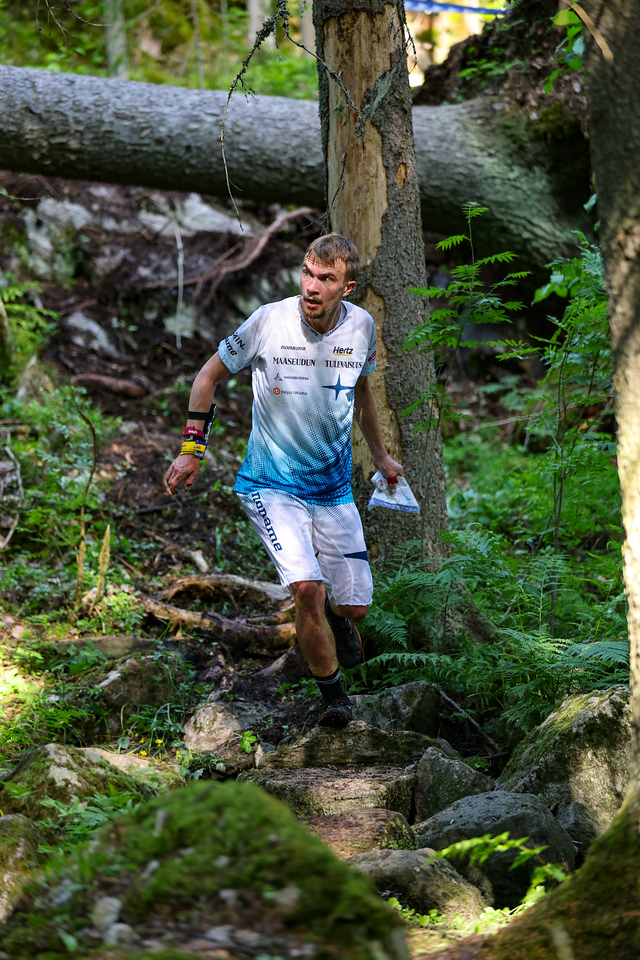
The Jukola Relay is one of the most demanding orienteering events in the world – both for athletes and their equipment. Noname Sport has grown from within the sport itself, and decades of experience are reflected in its products, services, and close collaboration with the orienteering community. This interview explores how extreme conditions, community, and Scandinavian identity shape the company’s approach.
1. Conditions and durability
The Jukola Relay is unforgiving on equipment, and the competition areas present a full range of challenges every year: freshly cut rough terrain, wet marshland, deep ditches, nighttime moisture and, at best, stifling heat in the afternoon. How do these extreme conditions influence Noname’s work at the design table – and what do durability and product life cycle mean to you in practical terms in this context?
Naturally, more than 25 years of experience in the field provides valuable perspective. Our company was originally founded to meet our own needs and those of our customers for products specifically developed for orienteering. Over the years, we have learned a great deal not only by doing, but also – and very importantly – by listening to our customers.
In concrete terms, this has meant significant effort in sourcing and testing hundreds of different materials over the years, seeking combinations that deliver both functionality and durability under the demanding conditions of the sport. This is reflected, for example, in the optimal proportion of Lycra fibers, carefully placed seams and weave structures, all without compromising breathability.
2. Clubs and community
Noname and Finnish club culture go hand in hand. How has the close dialogue with orienteering clubs influenced the services and ordering models you have developed over the years to serve communities of different sizes and their specific needs?
Here, the cause‑and‑effect relationship is very clear. Orienteering clubs possess a great deal of expertise, particularly in developing service quality and in matters requiring IT competence. This has helped us continuously improve our own operations as well. Naturally, these improvements also require financial investment, but we firmly believe this is something that pays off over time.
This can mean, for example, functional mobile solutions, the ability for clubs to place orders directly online, detailed size charts, virtual fitting rooms, and many other small features that make ordering easier. We are not yet exactly where we want to be in every area, but we are steadily moving in the right direction and improving over time. Most recently, our new warehouse opened alongside the Porvoo motorway in Söderkulla in January 2026.
3. Elite athletes vs. recreational participants
At Jukola, a world champion and a first‑time recreational orienteer may be wearing exactly the same outfit. How do you strike a balance in product development between the technical performance demanded by elite athletes and the comfort and durability needed by recreational users?
Our starting point is that recreational athletes also enjoy the sport more when their equipment performs well. It simply makes participation more comfortable, and from a sustainability and product‑circulation perspective, well‑functioning gear often remains in better condition. This can translate into higher resale value within a club, for example, or allow the product to serve as a long‑term training companion for the individual.
The biggest differences usually lie in certain technical details and cuts that distinguish elite products. Many items are nevertheless built using the same technical materials, while recreational users are often offered a slightly more relaxed fit for added comfort.
4. Northern identity
You describe yourselves as a “northern operator.” When the sun sets at Kotka‑Jukola and the weather turns unpredictable, how is this northern identity and expertise translated concretely into fabric fibers, technical solutions, and garment cuts?
In our marketing, we use the term “Scandinavian sports brand,” which naturally refers to our company’s Nordic character, with owners in Finland, Sweden, and Norway. Over the years, our test groups have also provided a major advantage across different sports, allowing us to test products in genuinely extreme conditions.
This involves, for example, ensuring effective moisture management or evaluating how garment cuts perform in dense and demanding terrain. All of this must, of course, be combined with sensible pricing for the end customer.
5. Enabling sport and Kotka‑Jukola
You speak a great deal about supporting and enabling sport. What is the most important measure of success for you in collaboration with a major event like Kotka‑Jukola – brand visibility, meaningful encounters in the competition village, or something deeper, such as a genuine love for the sport?
On a general level, we feel that we as a company have gained a great deal from orienteering as a sport. That is why it feels natural for us to be involved in enabling it, as the sport is very close to our hearts. It is also worth remembering that there are not many domestic companies investing in orienteering and its development. We want to be one of the leading companies in this regard.
In the case of the Jukola Relay, we are also responsible for operating the Jukola shop. Naturally, there are important financial metrics involved as well, which we aim to achieve together with the event organizers.
So there is no single correct answer – but without a doubt, Jukola relays also feel very much like a spiritual home to us, where the message is passed forward year after year. We work hard to ensure we succeed in delivering great experiences to our customers and in meeting many familiar faces again throughout the day, evening, night, and morning at Jukola.