
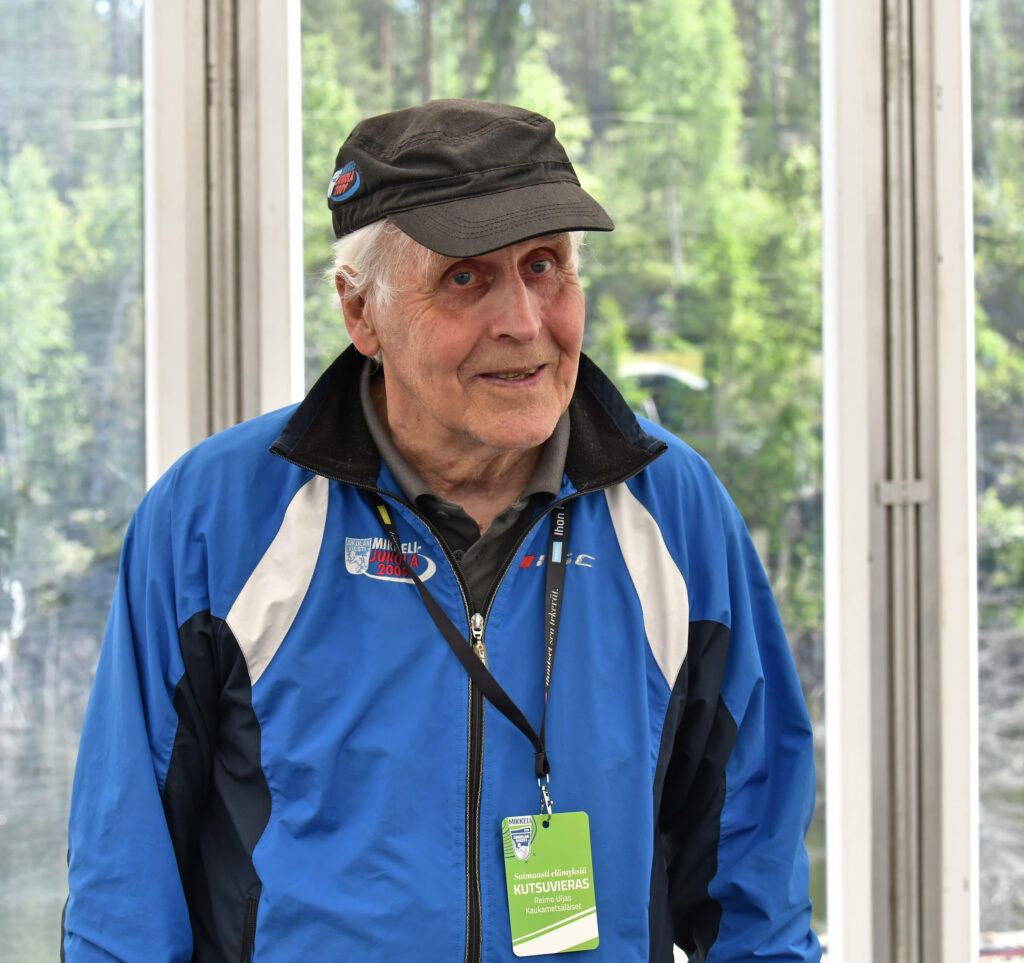
When Reimo Uljas was invited to the Presidential Independence Day Reception in 2025, the recognition came after more than seven decades of dedication to Finnish orienteering. It all began at Ressu, a school in the center of Helsinki.
At Ressu, physical education teacher Niilo Tammisalo—a former goalkeeper for the Finnish national football team—organized orienteering training sessions and school championships each autumn. Uljas performed well enough to take part in the Helsinki secondary school championships in the autumn of 1953.
“Considering my experience, the results were good—the spark remained.”
— Reimo Uljas
The following winter, Uljas attended courses organized by Helsingin Suunnistajat (Helsinki Orienteers) and asked a classmate to join him, as he was the only one of his age.
– I asked Seppo Saario to come along. And we’ve been on that path ever since. Perhaps what appealed to me was that besides using your legs, you also had to use your brain—since I was quite lazy when it came to training. That’s why I’ve mainly focused on organizing and club work.
Youth Work Born from Everyday Needs
In 1955, Uljas decided to teach the neighborhood boys how to orient.
– It wasn’t much fun to head out alone at six in the morning on Sundays, cycling to catch the northbound train. You also had to make sure there were enough teammates for relay events.
The solution was simple—but far-reaching.
– I taught the neighborhood boys. Every one of them stayed in the sport.
This sparked a desire to develop the club’s youth activities, which in the 1950s were still quite modest.
A Long-Term Commitment to School Orienteering
Over the decades, Uljas has played a central role in youth work within Helsingin Suunnistajat. What began as individual training sessions has grown into full seasonal programs, expanding from school maps to indoor concepts.
When the coordinator of the Pallomylly school indoor orienteering program stepped down, Uljas felt it was important to continue the activity. Later, when the club withdrew from organizing it, he assembled a senior team of around twenty people.
– Pallomylly is a great concept, but not all schools can get there. So I developed a maze orienteering format for schools’ own gym halls.
The concept quickly proved successful, with sessions held almost daily during the winter season.
“ For six years now, we’ve had over 10,000 participants annually. That’s close to the maximum capacity, as activities take place nearly five days a week.”
— Reimo Uljas
In addition, forest orienteering events are organized during the spring and autumn seasons.
– About 5,000 children take part each school year. The availability of instructors limits growth—there would be more demand. We hold 140–150 school orienteering days annually, and preparation takes almost another hundred days. I’ve also drawn more than 50 school maps—the latest just last week.
Development and the Long Arc of Jukola
Development work arises from necessity—and often from technological progress, Uljas notes.
“There have always been ‘inventive minds’ in orienteering. The truth is, if you stand still, you fall behind.”
— Reimo Uljas
In the 1980s, Uljas served on the board of the Finnish Orienteering Federation and in the Jukola relay leadership group, and later as chairman of Kaukametsäläiset.
– It’s a fine and multifaceted whole that you don’t learn overnight. At the same time, multiple events are underway at different stages, and future organizers are being sought. The leadership group’s role is to ensure quality and continuity.
– Jukola is a brand. It doesn’t experiment lightly, but it closely follows development.
The work has not always been easy.
– Sometimes you’ve had to speak in capital letters—though rarely.
Moments to Remember
One particularly memorable moment was the Jukola relay in Salo in 2006, where GPS tracking was introduced.
– Two of the leading runners went to the wrong hill. One was heard saying, ‘A million people know where we are—except us.
According to Uljas, the moment was a turning point:
– That’s when orienteering moved from the forests into people’s living rooms.
Another fond memory relates to Jukola’s international standing. When the World Championships threatened to displace Jukola’s traditional date, Uljas contacted former world champions abroad.
–They informed the federation that Jukola belongs before Midsummer. And that’s where it stayed.
Encounters and Meaning
Over his long career, Uljas has had countless encounters. One of them occurred unexpectedly in London.
– A young woman came up and asked if I was Reimo. She wanted to thank me for teaching her orienteering, which made it possible for her to take part in the Swedish Five Days. There, she met a pleasant British man.
– They now lived in a manor house outside London with two children.
Dozens of orienteers taught by Uljas have gone on to succeed in national and world championships as well as in the Jukola relay. Uljas himself, however, takes a modest view of such success.
– It’s certainly been nice to follow, but not everyone needs to become a champion.
He recalls how two boys once came out of the forest:
– Both had their pockets full of frogspawn. They were thrilled—their mothers somewhat less so.
Connections with former students can last for decades.
– When you receive an invitation to a graduation party or a wedding from a former student, it really moves you.
A similar feeling may arise at local orienteering events, when someone who has already ended their active career comes to introduce their partner to their former coach. There are many such moments, Uljas says.
An Invitation for the Whole Community
Uljas was invited to the Presidential Reception on December 6, 2025. However, he does not see the recognition as a personal achievement.
– Of course, it’s wonderful that 70 years of youth work like this is recognized. But no one runs an activity involving 18,000 children annually alone. It’s a collective effort. I attended the reception as a representative of that large group.
Text: Markku Sormunen